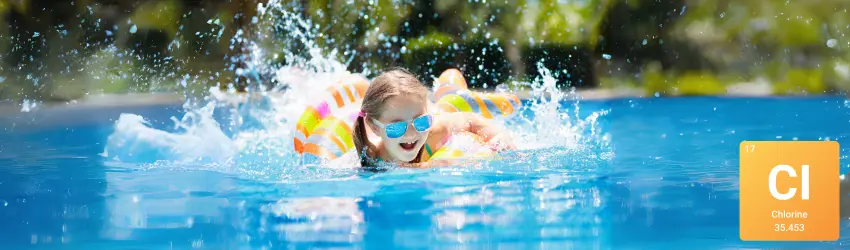

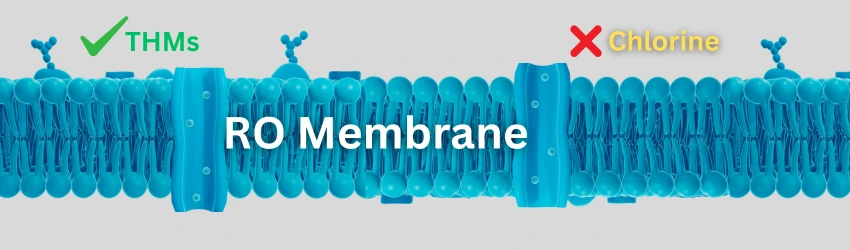
Chlorine compounds can be harmful to reverse osmosis (RO) membranes. Chlorine, in particular, is highly oxidative and can degrade the polyamide layer of most RO membranes, leading to reduced performance and membrane damage over time. That’s why pretreatment steps are often used to remove chlorine (e.g., with activated carbon filters or sodium bisulfite) before water passes through the RO system.
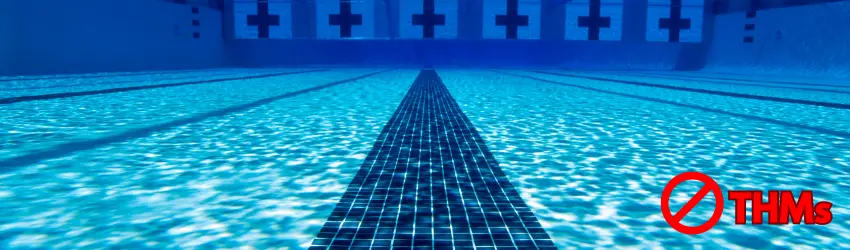
However, THMs (Trihalomethanes) behave differently from chlorine compounds in terms of their interaction with RO membranes. Here’s how:
1. THMs vs. Chlorine Impact on RO Membranes
- Chlorine (Cl₂): Chlorine is a small, highly reactive molecule that can break down the polyamide thin-film composite (TFC) membranes used in RO systems through oxidative damage. This reaction results in irreversible loss of membrane selectivity, which can significantly reduce the system’s ability to reject salts and other contaminants.
- THMs: THMs (e.g., chloroform, bromoform) are organic molecules that do not have the same oxidative properties as chlorine. While they can pass through the RO membranes, they do not degrade the membrane material like chlorine does. The primary concern with THMs in water treatment is their potential health risk, not their impact on the RO system itself.
2. THM Rejection by RO Membranes
RO membranes are capable of rejecting some percentage of THMs due to their molecular size and polarity. The rejection efficiency depends on the specific THM compound, membrane type, and operating conditions.
- Smaller THMs like chloroform (CHCl₃) may have lower rejection rates compared to larger organic molecules, but a high-quality RO system will still reduce THM concentrations.
- Brominated THMs, such as bromoform (CHBr₃), being slightly larger, may have better rejection compared to chloroform.
While RO membranes can remove a portion of the THMs, it is not their primary strength. RO is more effective at removing ions, salts, and other larger organic molecules. That’s why additional pre-treatment or post-treatment methods are often used in combination with RO to manage THMs effectively, such as:
- Activated carbon filtration before or after RO to target organic contaminants like THMs.
- Advanced oxidation processes (AOPs) can also be applied in tandem with RO systems to break down THMs or their precursors.
3. Managing Chlorine in RO Systems
If chlorine is present in the feedwater to the RO system (which can form THMs during disinfection), it is crucial to neutralize chlorine before it reaches the RO membranes. This is typically done through:
- Activated carbon filters, which remove chlorine by adsorption.
- Chemical dechlorination using agents like sodium bisulfite (NaHSO₃) or sodium metabisulfite (Na₂S₂O₅), which neutralize free chlorine.
Since THMs themselves do not cause oxidative damage, they are safe for the membrane in terms of physical interaction. However, the presence of chlorine in any form before RO will need to be managed carefully.
In summary:
- THMs do not harm RO membranes, unlike chlorine, which can cause oxidative damage. However, RO systems do not completely remove THMs, so additional treatment is often required for complete THM control.
- Pre-treatment steps (e.g., activated carbon filters, dechlorination agents) are essential in protecting the RO membrane from chlorine, while post-treatment may further reduce THM concentrations if needed.