
THMs: The Chlorine Byproduct Threat, and How to Get Rid of Them

Trihalomethanes (THMs) are a category of chemical substances which are by-products of the disinfection procedure used in the water treatment, and they are mainly formed when chlorine-based disinfectants react with natural organic matter (NOM) found within the water matrix. The reason why these compounds are of concern is due to the fact that they are considered to be potential carcinogens and are regulated in drinking water under the guidelines developed by agencies like the U.S Environmental Protection Agency (EPA) and the World Health Organization (WHO).
1. Formation of THMs
The process of THM formation takes place in several steps:
• Presence of Organic Matter: Natural organic matter (NOM) is a product of plant and algae decomposition, as well as other organic sources in the aquatic systems. It is composed of numerous organic substances such as humic and fulvic acids.
• Chlorination Reaction: During disinfection, when the chlorine (Cl 2 ) in the form of free chlorine (HOCl or OCl -) is added to water, it reacts with the NOM. This reaction is strong, especially in waters with higher amounts of dissolved organic carbon (DOC).
• Halogenation: Free chlorine helps to replace hydrogen atoms in the organic molecules with halogen atoms, mainly chlorine and bromine (where there are bromide ions). The results of this transformation are halogenated by-products, including trihalomethanes.
• Time and Temperature: The concentration of THMs grows as the duration of contact between chlorine and organic material increases and is additionally hastened at high temperatures.
• Relation to the pH: The pH of the water also affects the formation of THM, where higher concentrations are usually found at neutral to slightly alkaline pH levels.
The most common THMs formed are:
- Chloroform (CHCl₃)
- Dibromochloromethane (CHBr 2 Cl) is a volatile organic compound that is both a carcinogen and a neurotoxin.
- Dibromochloromethane (CHBr 2 Cl) is a volatile organic compound, a carcinogen, and a neurotoxin.
- Bromodichloromethane (CHBrCl 2 ) is the most frequently used solvent. The most commonly used solvent is bromodichloromethane (CHBrCl 2 ).
- Bromoform (CHBr₃)
These THMs can accumulate over time in water distribution systems if not properly managed.
2. Factors Influencing THM Formation
- Concentration of Organic Matter -The higher the concentration of NOM, the more likely to form THM.
- Chlorine Dose- Overdose of chlorine may increase levels of THM.
- Bromide Ions – When bromide is present in source water, there is the possibility of brominated THMs being formed, including bromoform and dibromochloromethane.
- Water Temperature- An increase in temperature increases the rate of reaction between chlorine and organic matter. pH – THMs can be easily synthesized in the range of neutral to alkaline pH, say 7 to 8.5.
3. Ways to minimise and eliminate THMs.
Several strategies can be implemented to reduce the formation of THMs or remove them after formation:
A. Reduce Precursors (Source Control)
• Enhanced Coagulation and Flocculation: This is done to eliminate NOM before chlorination, and hence, the likelihood of THM formation is minimized. Organic precursors are normally targeted using coagulants like alum or ferric chloride.
• Pre-treatment with Activated Carbon: Granular or powdered activated carbon may be used to adsorb organic matter before disinfection and reduce the formation of THM. GAC filters are especially effective in the regulation of the DOC.
• Pre-oxidation with Ozone or UV: Ozone and ultraviolet (UV) light are used as alternative disinfectants that do not form THMs. These technologies can also break down some of the organic precursors before chlorine is applied. Ozonation oxidizes complex organic molecules, making them less reactive with chlorine.
• Source Water Management: Reducing the input of organic material into source water bodies (e.g., through controlling agricultural runoff or managing algal growth in reservoirs) can help reduce NOM levels.
B. Alternative Disinfection Methods
• Chloramines (NH₂Cl): As mentioned earlier, using chloramines instead of chlorine for secondary disinfection can significantly reduce THM formation. Chloramines are less reactive with NOM, resulting in fewer disinfection by-products.
• Chlorine Dioxide (ClO₂): This alternative disinfectant is effective at controlling microbial contamination without forming significant amounts of THMs.
• Ozonation or UV Disinfection: Ozone and ultraviolet light are also alternative disinfectants that do not form THMs. There are also other organic precursors that are degraded by these technologies prior to the application of chlorine. Oxidation of complex organic molecules by ozonation makes them less reactive to chlorine.
Source Water Management – The inflow of organic material into source bodies can be reduced by limiting it, e.g. by regulating agricultural runoff or by controlling the growth of algae in reservoirs, to reduce NOM concentrations.
C. Post-Treatment Removal
• Aeration (Stripping THMs): THMs, especially chloroform, are volatile and can be removed from water using aeration. Techniques like air stripping or diffused aeration expose the water to air, allowing THMs to evaporate. This method is most effective in large tanks or contact chambers with high surface areas.
• Granular Activated Carbon (GAC): GAC can also be used in post-treatment to adsorb THMs. GAC filtration is an effective method for reducing THM levels in treated water, particularly in water distribution systems where THMs may continue to form.
D. System Management Practices
• Optimize Chlorine Dosing: Careful control of chlorine dose can help minimize the amount of chlorine added while still ensuring disinfection goals are met. Lower doses reduce the formation of THMs.
• Reduce Contact Time: Shorter contact times between chlorine and water (particularly in reservoirs or distribution systems) can limit THM formation.
• pH Control: Maintaining a pH that minimizes THM formation (typically slightly acidic to neutral pH) during chlorination can help reduce the levels of THMs.
Summary
• THMs are formed when chlorine reacts with organic matter in water, especially when there is a long contact time, higher temperatures, and neutral to alkaline pH.
• THM formation can be minimized by removing organic precursors through coagulation, activated carbon treatment, and alternative disinfectants like ozone or UV.
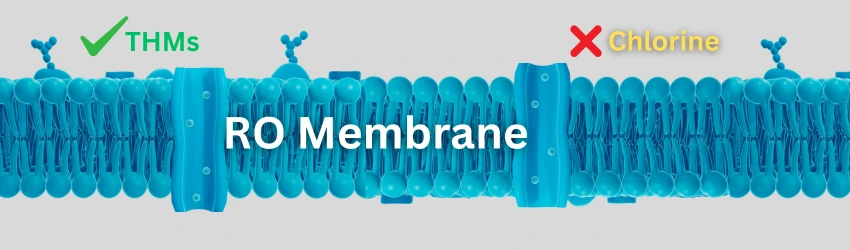
• Post-treatment methods, like granular activated carbon filtration, aeration, and reverse osmosis, can effectively remove THMs after they form.