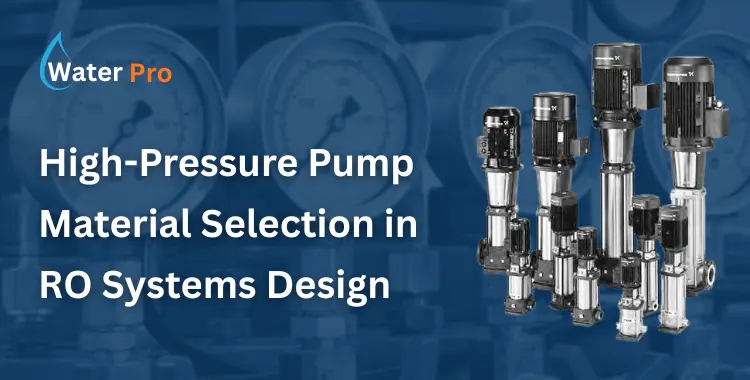
Selecting High-Pressure Pumps in RO Design Based on Feed Water TDS
Introduction
Choosing the high-pressure (HP) pump in reverse osmosis (RO) design based on the total dissolved solids (TDS) of the feed water is a critical aspect of the system design.
The TDS affects the osmotic pressure, which in turn influences the required operating pressure of the pump.
Key Considerations:
- Osmotic Pressure and Feed Water TDS
- Operating Pressure
- Pump Selection Based on TDS
- Flow and Recovery Rate
- Pump Efficiency and Energy Recovery
- Material Considerations
1. The osmotic pressure (π)
increases with higher TDS. It is calculated using this formula:
π = 0.0831 × T × TDS
Whereas:
T = The temperature in Kelvin
TDS = Total Dissolved Solids in mg/L.
0.0831 = derived from the universal gas constant
2. Operating Pressure:
The HP pump must overcome:
- the osmotic pressure
- The pressure drops across the membranes
- The pressure drops across the piping
Brackish Water RO: Typical pressures range from 100-300 psi (6.9-20.7 bar) depending on TDS.
Seawater RO: Typical pressures range from 800-1,200 psi (55-83 bar) due to higher osmotic pressure.
3. Pump Selection Based on TDS
Brackish Water RO (TDS <10,000 mg/L):
– Pumps with moderate pressure capabilities (100–300 psi) are suitable.
– Energy efficiency and flow rate are key parameters.
Seawater RO (TDS >30,000 mg/L):
– Pumps with high-pressure capabilities (up to 1,200 psi) are needed.
4. Flow and Recovery Rate, Pump Efficiency, and Energy Recovery
The required pump flow rate depends on:
1- system recovery rate
2- feed flow.
- Higher TDS feed water usually implies a lower recovery rate to prevent scaling and fouling.
- HP pumps must be capable of handling the required feed flow at the system’s design recovery.
5. Material Considerations
Pumps handling high-TDS water require corrosion-resistant materials like stainless steel (316L or duplex stainless steel) to withstand the corrosive environment.
Summary of Guidelines
TDS (mg/L) | Typical Application | Operating Pressure (psi) | (Bar) | Pump Material | Energy Recovery |
<1,000 | Tap Water | 5-150 | 3.5 – 10 | Standard Materials | None |
1,000 to 10,000 | Brackish Water | 100-300 | 7 – 20 | Stainless Steel (304/316L) | Sometimes |
> 30,000 | Sea Water | 800-1200 | 55 – 83 | Duplex- Super (*) | Essential |
* S.S 904L – (UNS N08904)